The Age of Reading Is Over. But Is It?
The Atlantic's new cover says it is. The decline is real — I've spent a year staring at the numbers while building against them. On where the blame actually belongs, and what an AI that refuses to summarize is for.
This week The Atlantic put a sentence on its cover that a lot of people already suspected was true: the age of reading is over. I have spent the last year building a reading app, so you might expect me to argue with it. I mostly can’t. The diagnosis looks right to me; it’s the cause I’d contest, and that disagreement is the whole reason the app exists.
The invoice
The numbers are real.
My first instinct was to file the cover under nostalgia, the way every generation announces the death of reading. Then I sat with the actual survey tables. Federal survey data show the share of U.S. adults who read any book in the prior year falling from about 55% in 2012 to under half by 2022 — the lowest fiction-reading rate in the survey’s thirty-plus-year history.[1] Across two decades of a time-use survey covering hundreds of thousands of Americans, the share reading for pleasure on a given day roughly halved, from around 28% to 16%, with the steepest drops among lower-income and less-educated readers.[2] The nation’s own report card tells the same story from the other end of life. Record shares of students now read below the “Basic” level, and the twelfth-grade reading score is the lowest ever recorded.[3]
None of which means people can no longer read. Almost everyone still can, which is why “illiteracy” is the wrong word for what is happening. The Atlantic’s word is post-literate, and I think it earns its keep. It describes a country surrounded by more text than any generation before it, drifting out of the habit of holding one long thought in the head for long enough to be changed by it.
The cause
Blaming the phone lets the software off the hook.
The comfortable story blames the phone, and there is some truth in it. But a phone is only hardware; it does what its software asks. The software is the part people like me actually chose to build, and for roughly fifteen years the industry’s most capable engineering talent has been handed some version of the same brief, which is to find whatever the user is doing and make it demand less of them.
So the feed took over deciding what you look at next. Summaries spared you the article itself. Now the answer engine spares you even the not-knowing, which used to be the thing that sent a person to a book. All of it arrived feeling like a gift, and I used most of it gratefully, without noticing that every convenience was also one more rep the reading muscle no longer got.
The muscle
Deep reading is a trained skill, and trained skills fade.
Deep reading, the kind where you lose the room, is not something brains do naturally. Maryanne Wolf, who has spent her career on the neuroscience of reading, describes the deep-reading circuit as something each brain has to build for itself over years of practice, and something that demonstrably weakens when that practice gets displaced by screen-skimming.[7] What effort built, convenience can take apart again. It doesn’t vanish the way keys vanish; it fades the way a language does when you stop speaking it, so gradually that you only notice on the day you reach for it.
The strange part is that the effort was doing the teaching all along. Learning scientists have half a century of work on this under the unlovely name of “desirable difficulties.” With the right kind of book, the struggle is where the learning happens, and when something goes down effortlessly, that smoothness is often a sign that not much of it will stay.[6]
The uncomfortable part
I built an AI app.
In an essay about the collapse of reading, that admission should set off an alarm. Let it. The most on-trend product I could have shipped this year is an AI that reads books for you. Point it at War and Peace, get four bullet points, feel briefly educated, move on. There are plenty of those now, and what early evidence we have on that trade is not comforting. Gerlich’s 2025 survey of 666 people found that the more participants leaned on AI tools, the worse their critical-thinking scores, with “cognitive offloading” (letting the tool do the thinking) carrying most of the association.[4] An MIT group put EEG caps on essay-writers and found the chatbot-assisted group showed the weakest brain connectivity of the three conditions, and most of them, minutes later, could not quote a line from the essay they had just produced. The researchers call it cognitive debt. [5] One is correlational and the other is a small preprint, and I want to keep both caveats attached. But the direction is consistent. When the machine does the work, the mind that skipped it keeps very little.
The obvious objection writes itself, an AI company complaining about AI. It would land, too, if my argument were that the technology is the problem. My argument is narrower. The products I mind are the ones that do the reading so you don’t have to. IO is AI all the way down; I have just spent a year pointing it in the opposite direction.
What I built instead
An AI that refuses to summarize.
IO reader’s twelve personas were not built to hand you a takeaway; they exist to make you read the actual page more closely. The Historian places a passage in the moment it was written. The Rhetorician shows you what a sentence is doing to you — word choice, rhythm, the move you felt but couldn’t name. A Critical Thinker surfaces the assumption you were about to read straight past. And the Questioner, the only one whose job is to press you rather than the text, asks escalating questions until you find out whether you actually understood.
None of them hand you a conclusion, and none of them will shorten the book. A summary stands in for the text; these stand around it, and you still read every word yourself. For a while I worried that made the product sound like homework. I have stopped apologizing for it, because it is the design. I made the fuller case for it elsewhere, and the whole evidence base — the studies behind every claim above — lives in our research review.
I know how this sounds. The phone is where attention goes to die, and here I am putting a reader on it — the people who take reading most seriously reach for e-ink precisely to get off the glass. But most people won’t, and I didn’t want to build only for the ones who already read. So instead of pretending to be paper, IO does something less precious and borrows the design that makes the feeds so hard to put down — the scroll, the one-thing-at-a-time swipe — and points it at the canon. Reading in it can be a feed where every post is a paragraph of the book, or a swipe where each card is a single line worth sitting with. What separates it from the feed you would otherwise be in has little to do with the interface. You chose the book, nothing is deciding your next hit, and the AI is there to deepen the page rather than summarize it away. It can’t stop you from leaving for TikTok. The most it can do is be absorbing enough that you don’t want to.
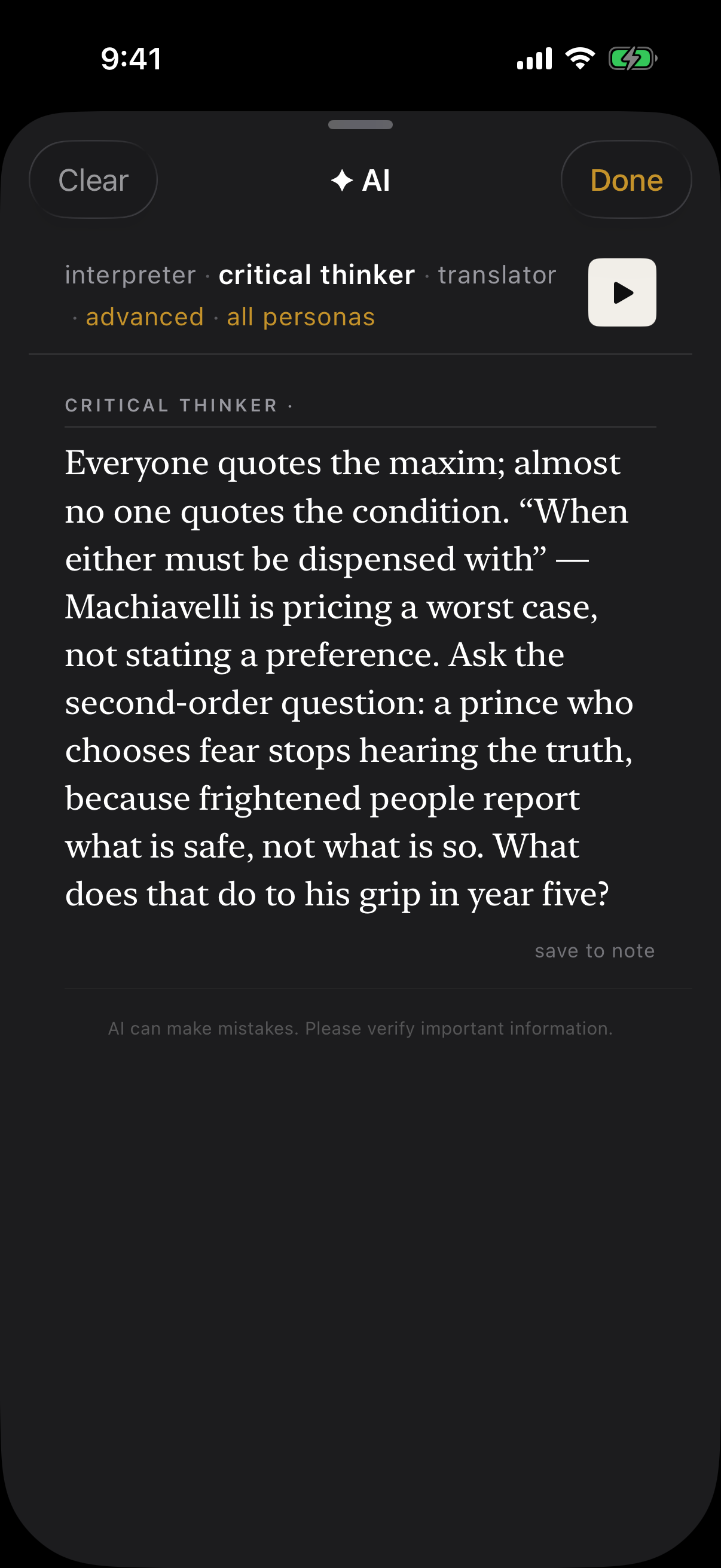
With the right kind of book, the struggle is where the learning happens.
The question underneath the whole build was whether this technology could be aimed at the opposite goal — whether it could make a hard book more reachable, and richer, without doing any of the reading for you. Something closer to reading alongside a well-read friend than to being read to.
It is one person’s bet, live on the App Store, and honestly almost nobody has noticed it yet. I keep making it anyway, because the entire industry is currently betting the other way, and The Atlantic’s cover reads to me like the invoice for fifteen years of that. From the inside, a post-literate age looks like weather, something that simply rolled in. Up close it is the compound interest on a design choice, repeated a few thousand times, always in the same direction. Choices can be remade. If software wants to do something genuinely valuable next, it could stop shaving seconds off our days and start giving back the capacity to sit inside one difficult thought for an hour. Reading is how most of us got that capacity in the first place, and I don’t know a better way back to it than the actual page.
References
Every empirical claim above links to its source, from federal reading surveys and peer-reviewed studies to the canonical work on the reading brain. Where a finding is correlational or drawn from a small sample, we say so rather than rounding it up.
-
National Endowment for the Arts (2024) survey
Federal Data on Reading for Pleasure: All Signs Show a Slump. NEA (2022 Survey of Public Participation in the Arts).
In federal survey data, U.S. adults reading any book in the prior year fell from 54.6% (2012) to 48.5% (2022), and novel- or short-story reading dropped to 37.6% — the lowest fiction-reading rate in the survey’s 30-plus-year history.
View source ↗ -
Bone, Bu, Sonke & Fancourt (2025) survey
The decline in reading for pleasure over 20 years of the American Time Use Survey. iScience, 28(9).
Across 236,270 Americans (2003–2023), the share reading for pleasure on a given day fell from ~28% to ~16% — down roughly 40% — with the steepest drops among lower-income and less-educated groups.
View source ↗ -
Nation’s Report Card (NCES) (2025) survey
The Nation’s Report Card: 2024 NAEP Reading Assessment Results. U.S. Dept. of Education, IES (NAEP).
The 2024 U.S. assessment found reading down ~5 points since 2019 at grades 4 and 8, the lowest-ever 12th-grade score, and record shares of students — roughly 40% of 4th-graders — reading below the “Basic” level.
View source ↗ -
Gerlich (2025) survey
AI tools in society: Impacts on cognitive offloading and the future of critical thinking. Societies, 15(1).
Among 666 people, heavier AI-tool use correlated strongly with weaker critical-thinking scores (r = −0.68), a link explained by “cognitive offloading” — letting the tool do the thinking. The design is correlational, and the author cautions it cannot prove cause.
View source ↗ -
Kosmyna, Hauptmann, Yuan et al. (2025) neuroimaging
Your Brain on ChatGPT: Accumulation of cognitive debt when using an AI assistant for essay writing task. MIT Media Lab (arXiv:2506.08872).
In an EEG study of 54 writers, ChatGPT users showed the weakest brain connectivity, and 83% couldn’t quote a sentence from the essay they’d just produced — what the authors call “cognitive debt.” A small, not-yet-peer-reviewed preprint, so suggestive.
View source ↗ -
Soderstrom & Bjork (2015) review
Learning versus performance: An integrative review. Perspectives on Psychological Science, 10(2).
The review of “desirable difficulties,” showing that tactics that smooth the moment — cramming, re-reading, being handed answers — boost short-term performance but undercut durable learning.
View source ↗ -
Wolf (2018) book
Reader, Come Home: The Reading Brain in a Digital World. Harper / HarperCollins.
Wolf’s case that the “deep-reading circuit” — attention, memory, inference, analysis, empathy working at once — has to be built through practice and can weaken under screen-driven skimming. Her remedy is “biliteracy,” building deep reading first and then adding fluent digital reading.
View source ↗
← All Posts