Why Read the Classics in the AI Era?
A machine can now compress any book into a tidy paragraph. The paragraph delivers the conclusion — and drops the only part that changes you.
It has never been easier to find out what a book says, and never been less common to actually read one. Ask a machine for the gist of Middlemarch or the Meditations and it will hand you a clean paragraph in seconds. A month spent inside a long, difficult, centuries-old book therefore needs a defense it never used to, and the defense cannot rest on the book’s conclusions, since those are now a tap away; it rests on what the tap removes, which happens to be the only part of reading that changes the reader.
The shortcut
A machine can summarize anything now.
This is genuinely new, and I don’t think it can be waved away. For most of history the friction of reading was unavoidable. If you wanted the argument of a hard book, you had to climb it. That friction is now optional. And the early evidence on what happens when we take the shortcut is not reassuring. In a study of 666 people, heavier reliance on AI tools tracked with weaker critical-thinking scores, and the link ran through what the author calls “cognitive offloading,” letting the tool do the thinking.[1] An MIT experiment wired up essay-writers; the group leaning on a chatbot showed the weakest brain connectivity, and afterward most could not quote a single line they had just “written.” The researchers’ name for this is cognitive debt.[2] Both findings carry caveats (one is correlational, the other a small preprint), but they point the same direction. When the machine does the work, the mind that should have done it comes away with nothing.
A summary is the purest form of that trade — the author’s destination, delivered without the journey. With a classic, the journey is the whole inheritance.
The illusion
The summary was never the point.
Learning science has studied the value of difficulty for half a century, and the verdict is consistent. With the right kind of book, the effort is itself the mechanism of understanding. Bjork’s name for these is “desirable difficulties,” and the blunt corollary is that the convenience of a shortcut is often the very signal that little is being learned.[3] A book you can absorb at a glance probably has little to teach you. The one that resists is doing something to your mind in the resisting.
This is why the great readers always described reading as work. Mortimer Adler’s How to Read a Book sorts reading into levels and argues that demanding books reward “analytical reading” — the active labor of grasping a book’s structure and judging its argument in the author’s own terms.[4] You cannot outsource that and still have done it, any more than you can outsource your way to fitness. And the deepest books never sit still long enough to be finished off by a paragraph. Italo Calvino’s famous definition is that a classic is “a book that has never finished saying what it has to say,” one for which every rereading is “a voyage of discovery.”[5] A summary pretends to close a book that, on Calvino’s definition, cannot be closed.
A summary gives you the answer to a question the book was trying to teach you how to ask.
The case for old
Why old books, specifically.
“Classic” sounds like an honorific, but it is closer to a statistical fact about survival. Nassim Taleb’s “Lindy effect” holds that for ideas and books — things that do not age like bodies — the longer something has already lasted, the longer it is likely to keep lasting; a book in print for a century is a fair bet to be read in another.[6] Every generation that could have let Hamlet or the Analects drop chose instead to carry it forward. A recommendation algorithm is tuned to this week; the canon is a filter run by time, working against the bias Taleb calls “neomania,” the appetite for the new for its own sake.
The payoff of reading widely and well is also unusually well-measured. The sheer amount a person reads predicts vocabulary, general knowledge and comprehension years later, even after accounting for early ability, because most of our words are absorbed through reading rather than taught.[7] In a British cohort of six thousand, reading for pleasure in childhood predicted gains in vocabulary — and even in mathematics — larger than the advantage of having highly educated parents.[8] Hard books are where that vocabulary and that range live. Maryanne Wolf’s account of the “deep-reading circuit” — attention, memory, background knowledge, inference and empathy firing at once — is exactly the equipment a difficult classic demands and, in demanding it, keeps in tune.[9]
What it builds
What a classic builds that a summary can’t.
The most important thing reading does is the hardest to put on a dashboard. Martha Nussbaum argues that novels cultivate the “literary imagination” — the capacity to inhabit another person’s interior life and weigh experiences unlike your own — and she treats that capacity as an ingredient of moral reasoning and of a decent public life.[10] Some understanding, she contends, is emotional and particular, bound to specific people and situations, and so cannot be fully stated in the abstract; close reading of a great novelist becomes a mode of insight in its own right.[11] These are philosophical arguments rather than lab results — but the lab has begun to echo them. Daily brain scans found that reading a novel raised connectivity in regions tied to taking another’s perspective, with a trace lingering for days after the last page.[12]
The limits matter here, because overclaiming is its own kind of shortcut. A celebrated experiment found that reading literary fiction briefly sharpened the ability to read others’ emotions;[13] a large, three-lab replication then found no such instant effect, and concluded that what actually predicts social understanding is not one passage but a lifetime of reading.[14] Which is the more interesting result anyway. On that evidence the classics work less like a pill than like a practice, and a summary is a practice you never did.
The design bet
So what is AI actually for?
If the summary is the wrong use of a machine, there is a right one. What keeps most people out of the classics is rarely laziness. The first twenty pages are genuinely hard — the diction is strange, the references have gone cold, the sentences are built to a rhythm we no longer hear. Skipping the climb is no answer to that. What helps is a hand on the holds you cannot yet reach, so that the rest of the climb stays yours. Education’s word for this is scaffolding.
Vygotsky called the space just past what you can manage alone the “zone of proximal development,” the territory the right help brings into reach, and the training ground for doing without the help.[15] The term “scaffolding” itself comes from a study of tutors who controlled the parts of a task beyond a learner’s grasp so the learner could complete the rest and build toward doing it unaided.[16] And the defining feature of scaffolding — the one that separates it from doing the work for someone — is that it fades. Real scaffolding is contingent on need, gradually withdrawn, and hands control back to the learner.[17] By that definition a permanent summary is the opposite of scaffolding; it never fades and never hands anything back. Software-delivered scaffolding, by contrast, has a measurable, moderate benefit across many studies when it is built to support rather than to substitute.[18]
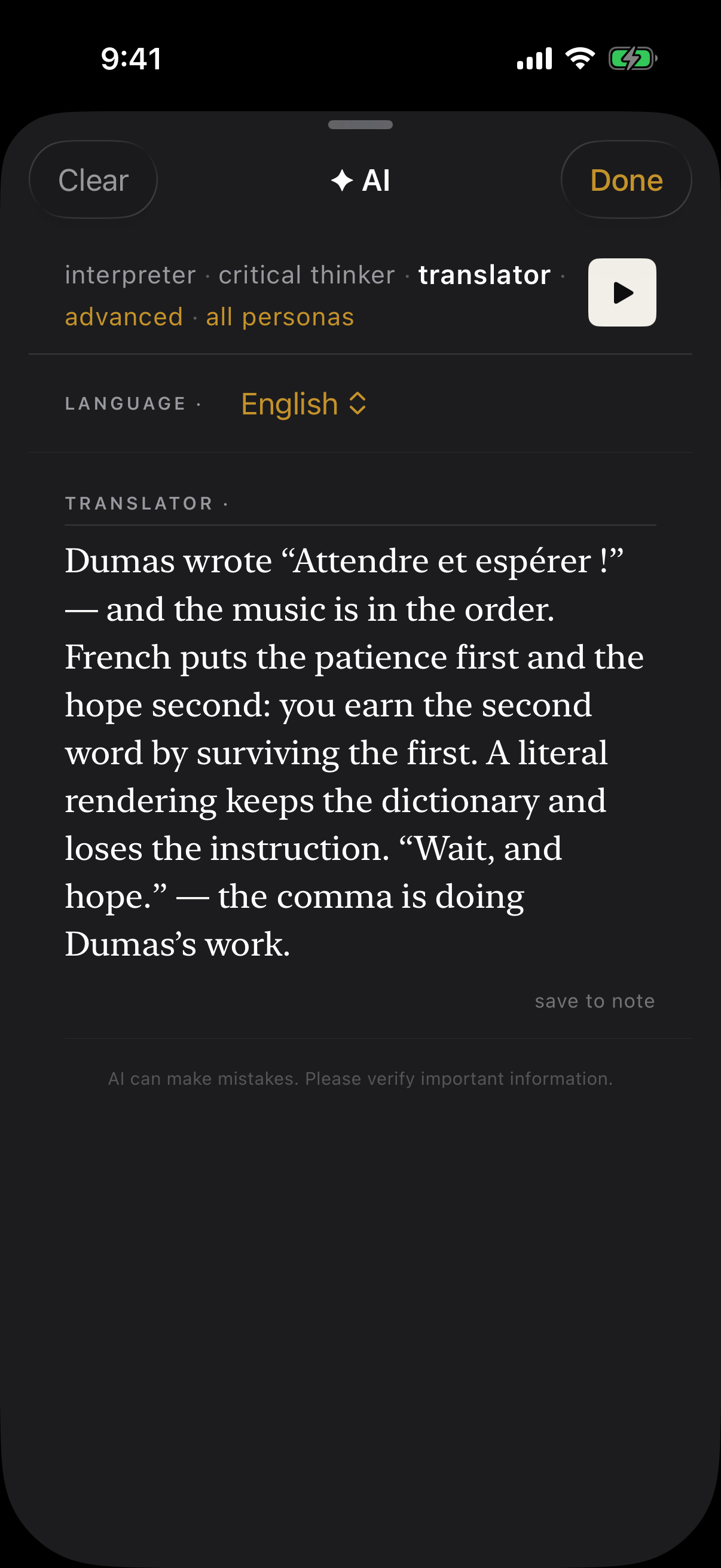
That is the line IO is built on. The Historian thaws a frozen reference. The Interpreter takes a knotted sentence and hands it back in words you can carry. The Translator ferries the music of the original across a language barrier, and the Critical Thinker holds the book’s own argument up to the light. None of them reads the book for you; each is there to keep you in it — on the hard page, doing the work, with just enough help to make the next paragraph possible. The goal is to make the classic climbable rather than easy, and then to step back.
A classic also carries the prejudices of its age, and reading one well means arguing with it, not kneeling to it — which is itself a reason to read the whole thing rather than a sanitized digest of it. The machine that matters is the one honest enough to keep you in the book, not the one that spares you from it.
References
Every empirical claim above links to its source — peer-reviewed studies, meta-analyses, and the canonical works on reading and learning. Where a claim is philosophical, contested, or drawn from a small sample, we say so rather than rounding it up.
-
Gerlich (2025) survey
AI tools in society: Impacts on cognitive offloading and the future of critical thinking. Societies, 15(1).
Among 666 people, heavier AI-tool use correlated strongly with weaker critical-thinking scores (r = −0.68), a link explained by “cognitive offloading” — letting the tool do the thinking. The design is correlational, and the author cautions it cannot prove cause.
View source ↗ -
Kosmyna, Hauptmann, Yuan et al. (2025) neuroimaging
Your Brain on ChatGPT: Accumulation of cognitive debt when using an AI assistant for essay writing task. MIT Media Lab (arXiv:2506.08872).
In an EEG study of 54 writers, ChatGPT users showed the weakest brain connectivity, and 83% couldn’t quote a sentence from the essay they’d just produced — what the authors call “cognitive debt.” A small, not-yet-peer-reviewed preprint, so suggestive.
View source ↗ -
Soderstrom & Bjork (2015) review
Learning versus performance: An integrative review. Perspectives on Psychological Science, 10(2).
The review of “desirable difficulties,” showing that tactics that smooth the moment — cramming, re-reading, being handed answers — boost short-term performance but undercut durable learning.
View source ↗ -
Adler & Van Doren (1972) book
How to read a book: The classic guide to intelligent reading. Simon & Schuster (Touchstone).
Adler and Van Doren’s four levels of reading — elementary, inspectional, analytical, syntopical — argue that demanding books reward “analytical reading”: active work to grasp a book’s structure and judge its argument. Understanding comes through effort, not passive reception. (A prescriptive method, not an empirical study.)
View source ↗ -
Calvino (1986) book
Why read the classics?. The New York Review of Books; collected, Pantheon (1999).
Calvino’s essay offers fourteen definitions of a “classic” — among them, “a book that has never finished saying what it has to say,” and a book of which every rereading is “a voyage of discovery.” An argument by aphorism: classics are inexhaustible and reward active rereading, not a single pass.
View source ↗ -
Taleb (2012) book
Antifragile: Things that gain from disorder. Random House.
Taleb’s “Lindy effect”: for ideas and books, the longer something has already survived, the longer it is likely to last — a book in print a century can be expected to last roughly another. He contrasts this with “neomania,” the bias toward the new. (A heuristic, not an empirical law; it speaks to survival, not quality for any one reader.)
View source ↗ -
Cunningham & Stanovich (1997) observational
Early reading acquisition and its relation to reading experience and ability 10 years later. Developmental Psychology, 33(6).
Following children for a decade, the sheer amount of print a student read predicted later vocabulary, general knowledge and comprehension — even after accounting for early IQ. Most vocabulary is absorbed through reading, not direct teaching.
View source ↗ -
Sullivan & Brown (2015) observational
Reading for pleasure and progress in vocabulary and mathematics. British Educational Research Journal, 41(6).
Across ~6,000 Britons, reading for pleasure between ages 10 and 16 predicted greater progress in vocabulary, spelling and even mathematics — and the vocabulary boost was larger than the effect of having highly educated parents.
View source ↗ -
Wolf (2018) book
Reader, Come Home: The Reading Brain in a Digital World. Harper / HarperCollins.
Wolf’s case that the “deep-reading circuit” — attention, memory, inference, analysis, empathy working at once — has to be built through practice and can weaken under screen-driven skimming. Her remedy is “biliteracy,” building deep reading first and then adding fluent digital reading.
View source ↗ -
Nussbaum (1995) book
Poetic justice: The literary imagination and public life. Beacon Press.
Nussbaum argues that reading novels cultivates the “literary imagination” — the capacity to enter another person’s interior life and weigh experiences unlike one’s own — and treats it as an ingredient of moral reasoning. (A philosophical argument by close reading, not a measured effect.)
View source ↗ -
Nussbaum (1990) book
Love’s knowledge: Essays on philosophy and literature. Oxford University Press.
Nussbaum’s case that some ethical understanding is emotional and particular — bound to the perception of specific people and situations — and so cannot be fully stated without literary forms; close reading of authors like James can itself be a mode of insight. (A contested philosophical thesis.)
View source ↗ -
Berns, Blaine, Prietula & Pye (2013) neuroimaging
Short- and long-term effects of a novel on connectivity in the brain. Brain Connectivity, 3(6).
Daily brain scans found that reading a novel raised connectivity in regions tied to perspective-taking, with a sensory-motor boost lingering for days after the book was finished. (The sample was small — 19 readers — so treat it as suggestive.)
View source ↗ -
Kidd & Castano (2013) rct
Reading literary fiction improves theory of mind. Science, 342(6156).
Five experiments found that reading a few pages of literary fiction briefly improved “theory of mind” — reading others’ emotions — more than popular fiction or nonfiction. Much-cited, but contested (see the replication that follows).
View source ↗ -
Panero, Weisberg, Black et al. (2016) rct
Does reading a single passage of literary fiction really improve theory of mind? An attempt at replication. Journal of Personality and Social Psychology, 111(5).
A 792-person, three-lab replication found no instant empathy boost from one literary passage. What predicted social skill was a lifetime of reading, not the assigned text — the honest counterweight to the 2013 result.
View source ↗ -
Vygotsky (1978) book
Mind in society: The development of higher psychological processes. Harvard University Press.
Vygotsky’s “zone of proximal development”: the gap between what a learner can do alone and what they can do with guidance. The right help brings the just-out-of-reach into reach — today’s reach-with-help becomes tomorrow’s reach-alone. (Posthumous edited essays; the ZPD is hard to measure precisely.)
View source ↗ -
Wood, Bruner & Ross (1976) observational
The role of tutoring in problem solving. Journal of Child Psychology and Psychiatry, 17(2).
The paper that coined “scaffolding”: a tutor controls the parts of a task beyond the learner’s reach so the learner can do the parts within reach — recruiting interest, simplifying steps, marking what matters — with the aim of building competence toward unaided performance. (Small observational study of preschoolers.)
View source ↗ -
van de Pol, Volman & Beishuizen (2010) review
Scaffolding in teacher–student interaction: A decade of research. Educational Psychology Review, 22(3).
A review distilling scaffolding to three features: contingency (tuned to the learner’s need), fading (gradually withdrawn), and transfer of responsibility (the learner takes over). Help that never fades or hands control back is not really scaffolding. (A qualitative synthesis.)
View source ↗ -
Belland, Walker, Kim & Lefler (2017) meta analysis
Synthesizing results from empirical research on computer-based scaffolding in STEM education: A meta-analysis. Review of Educational Research, 87(2).
Across 144 studies, computer-delivered scaffolding had a consistent, moderate benefit (g ≈ 0.46), holding across age groups — well-designed software support genuinely aids learning. (Scope is STEM problem-solving, not literary reading.)
View source ↗
← All Posts