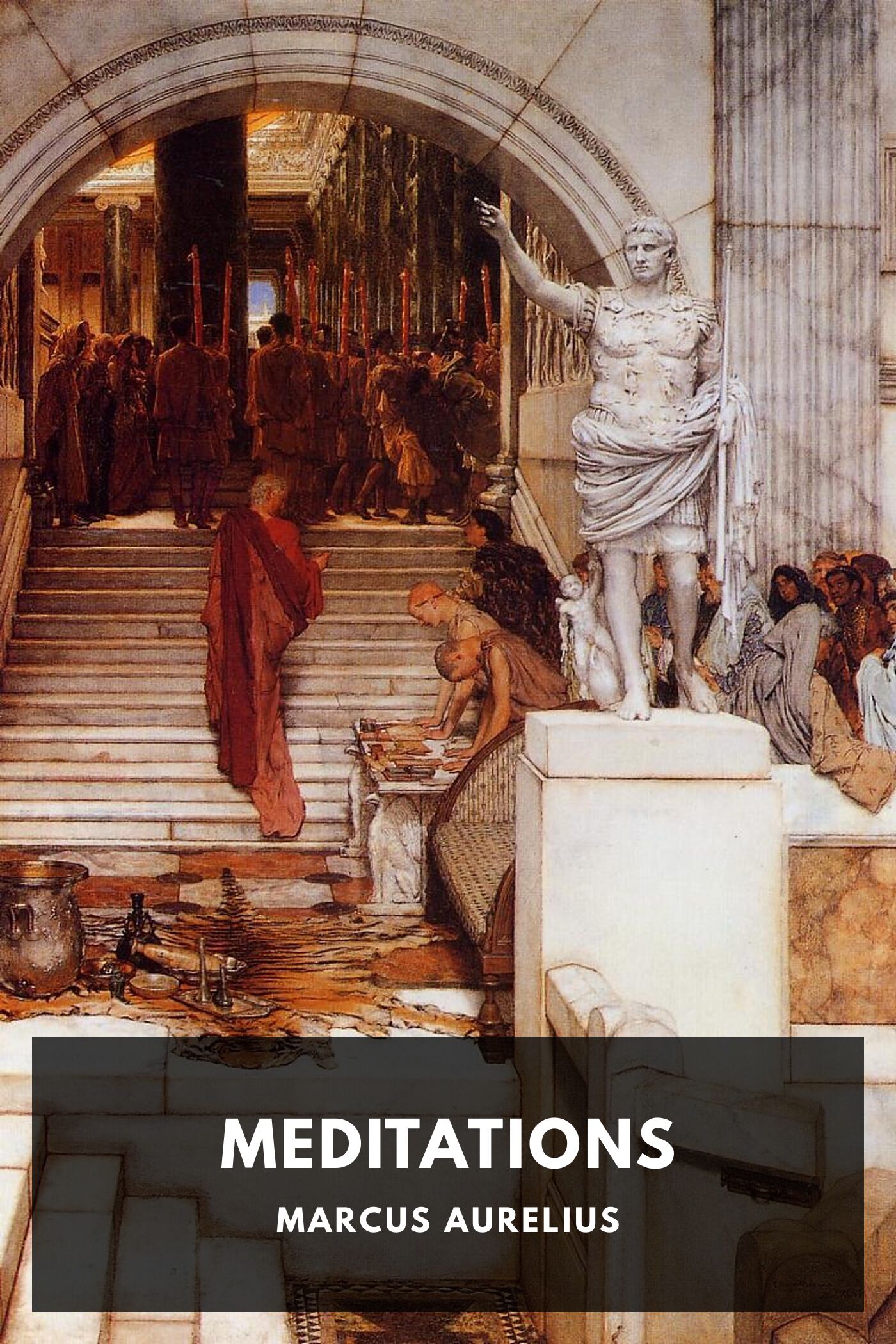
Marcus Aurelius · 180 · George Long translation
Meditations
Meditations is the private notebook the Roman emperor Marcus Aurelius kept for himself around 170 CE — short Stoic reminders about duty, mortality, and other people’s failings. The Philosopher reading companion in IO reader draws out the Stoic argument in each entry. This is Long’s public-domain translation, not the copyrighted modern ones.


Read the opening in Reels
PART I · PARAGRAPH
Begin the morning by saying to thyself, I shall meet with the busybody, the ungrateful, arrogant, deceitful, envious, unsocial. All these things happen to them by reason of their ignorance of what is good and evil. But I who have seen the nature of the good that it is beautiful, and of the bad that it is ugly, and the nature of him who does wrong, that it is akin to me, not only of the same blood or seed, but that it participates in the same intelligence and the same portion of the divinity, I can neither be injured by any of them, for no one can fix on me what is ugly, nor can I be angry with my kinsman, nor hate him. For we are made for cooperation, like feet, like hands, like eyelids, like the rows of the upper and lower teeth. To act against one another then is contrary to nature; and it is acting against one another to be vexed and to turn away.
Begin the morning by saying to thyself, I shall meet with the busybody, the ungrateful, arrogant, deceitful, envious, unsocial.
Meditations · Marcus Aurelius · tr. George Long
Interactive demo — real text, web replica of the reading view
Read it with a reading companion
Surfaces the philosophical question or tradition embedded in the text.
Read it with the Philosopher in IO reader.
Response from the Philosopher in IO reader · 2026-09-04
This passage centers on the Stoic imperative of cosmopolitanism, framing human conflict as a fundamental misunderstanding of our shared rational nature. By recognizing that the wrongdoer acts out of ignorance rather than malice, you detach your own moral integrity from the external behavior of others. You are not merely an individual, but a functional limb of a singular, interconnected organism designed for mutual support. If your neighbor’s cruelty is merely a symptom of their own ignorance, does your resentment serve any purpose other than to alienate yourself from your own nature?
The facts
| Length | about 51,800 words · 1,860 sentences |
|---|---|
| In sentence cards | about 124 minutes |
| Difficulty | gentle |
| First line | Begin the morning by saying to thyself, I shall meet with the busybody, the ungrateful, arrogant, deceitful, envious, unsocial. |
| Themes | Book I · Book II · Book III · Book IV · Book V · Book VI · Book VII · Book VIII · Book IX · Book X · Book XI · Book XII |
Is Meditations hard to read?
No — it is short private notes to himself, not a treatise, and reads well in small daily doses. In sentence cards it's about 124 minutes total.
Which translation is this?
George Long's 19th-century translation, in the public domain (from Standard Ebooks, not the copyrighted Hays translation).
How long is Meditations?
About 51,800 words across twelve books; roughly 1,860 sentences.
Read Meditations in IO reader
Colophon
Text: George Long translation, from Standard Ebooks (se:marcus-aurelius/meditations/george-long). Cover: Standard Ebooks CC0 cover, marcus-aurelius/meditations/george-long. Reviewed 2026-09-04.