Meet Your Experts: IO’s Twelve AI Personas
Most AI reading tools just summarize. IO ships twelve personas instead, each a different way of staying inside a passage rather than skimming past it. Here's the whole bench, and the science behind it.
Most AI reading tools work the same way. Highlight a word, get a definition; highlight a passage, get a summary. Useful, as far as it goes, but shallow, because it casts the AI as a dictionary when it could be a thinking partner. IO was built around a different question. What kind of intellectual relationship do you need with this sentence, right now? The answer we landed on was twelve assistants rather than one, each a different way of going deeper.
The design choice
Why twelve, and not one summary button.
The summary is the obvious thing to build and the wrong default. The early evidence on leaning hard on AI is sobering. In a study of 666 people, heavier reliance on AI tools tracked with weaker critical-thinking scores, the link running through “cognitive offloading.”[1] An MIT experiment found that essay-writers leaning on a chatbot showed the weakest brain connectivity and mostly could not quote a line they had just produced.[2] The lesson is narrower than “avoid AI.” Learning happens on whichever side of the exchange does the work.
The work, specifically, is generative. We remember what we produce far better than what we are handed — the “generation effect.”[3] The closest study skill is self-explanation. The readers who quietly explain a text to themselves understand it far more deeply than those who reread,[4] an effect demonstrated when students prompted to explain each sentence built better mental models than those who simply read twice,[5] and confirmed across dozens of studies as a reliable, low-cost gain.[6] A landmark review of study techniques rates self-explanation and asking “why is this true?” as genuinely useful — a clear step above the passive habits of rereading and highlighting.[7] One framework even ranks learning by engagement, with dialogue and questioning at the top and passive reception at the bottom.[8] Every IO persona is built to pull you up that ladder, and none of them will read the book for you.
Each persona is less a shortcut through the text than a reason to stay inside it a little longer.
Where you start
The three you begin with.
Three personas are on by default, the relationships nearly every reader needs sooner or later. The Interpreter makes a hard sentence legible. The Critical Thinker works in the other direction, teaching you to be properly suspicious of an easy one. And the Translator carries meaning across a language without dropping its register.
- The Interpreter — Rewrites a thorny passage to match your reading level and taste — clearer, never dumber — so a knotted sentence becomes one you can carry.
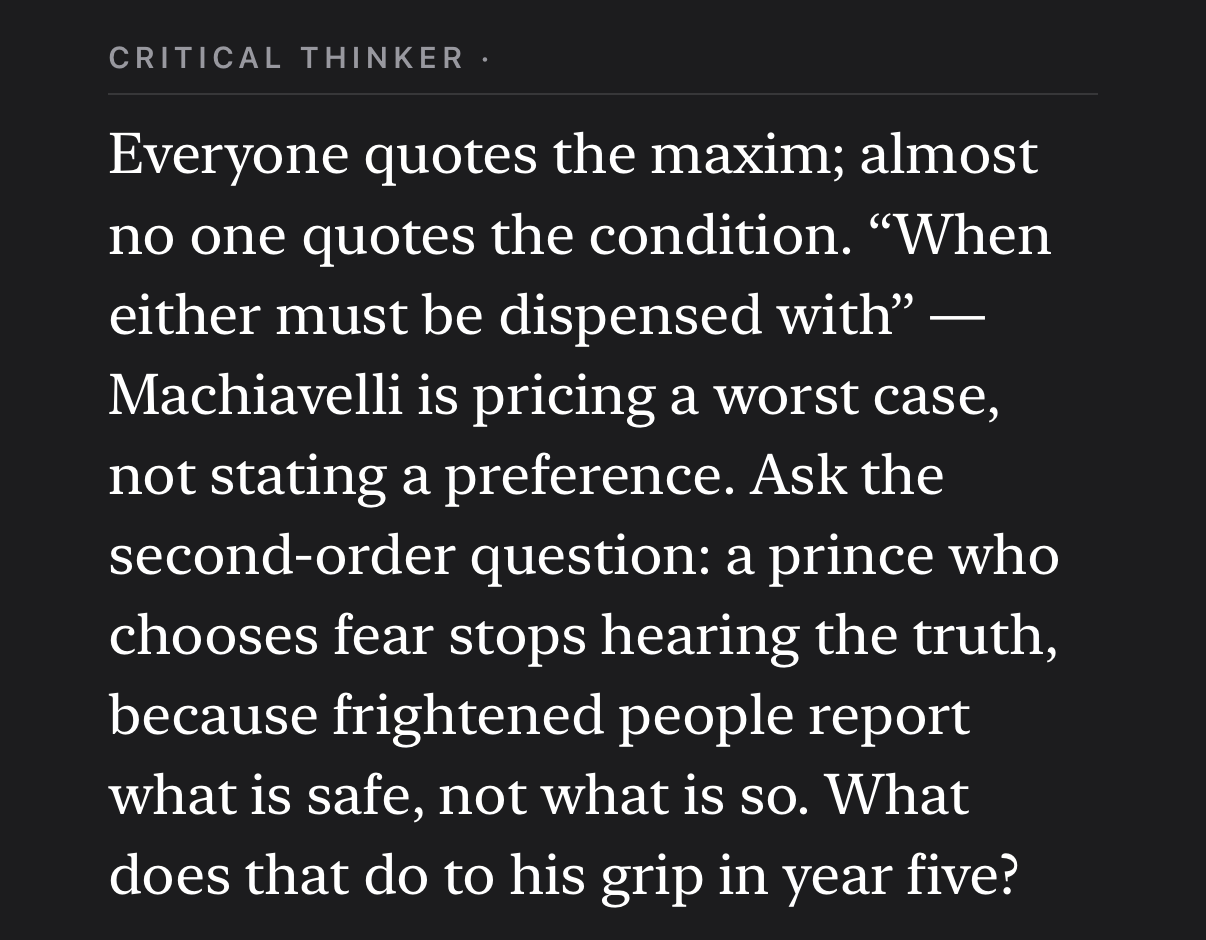
- The Critical Thinker — Surfaces the hidden assumptions and second-order implications a careful reader would catch, and refuses to let you nod along.
- The Translator — Carries the passage into your language with native-speaker naturalness — keeping the music of the original rather than flattening it.
Going deeper
Five ways to read against the grain.
The next five turn a passage to the light from different angles — history, philosophy, psychology, craft, and pure interrogation. The last of them, the Questioner, is deliberately Socratic. It answers a passage with sharper questions rather than conclusions. That instinct is well-founded. One-to-one tutoring is among the most powerful interventions education has measured — Bloom’s studies put it about two standard deviations above a normal classroom.[9] A later, more conservative review put human tutoring nearer 0.8 of a standard deviation, and, tellingly, found that interactive computer tutors recovered most of that benefit; the gain, it seems, lives in the back-and-forth rather than in the verdict.[10]
- The Historian — Sets the passage back in its historical and cultural moment, thawing references that have gone cold with time.
- The Philosopher — Names the philosophical question or tradition pressing underneath the text, and what is at stake in answering it.
- The Psychologist — Reads character — motivation, emotional pattern, the psychological dynamics moving beneath what people say and do.
- The Rhetorician — Dissects the craft, from word choice to rhythm to the devices doing the persuading, so you see how the effect is made.
- The Questioner — The Socratic one. Asks escalating questions that challenge your assumptions about the passage instead of resolving them for you.
Making it stick
Four that make it last.
The final four are built for retention — the difference between having read a thing and keeping it. The Quiz Master leans on the best-evidenced technique in all of learning science. Testing yourself beats rereading, and by a wide margin a week later.[11] The Vocab Coach works the channel through which most of our words are actually learned — context in real reading, not lists.[12] And the Note-Taker reflects a subtle finding. Notes help most when they force you to reframe an idea in your own words rather than transcribe it, which is exactly the structured note it builds.[13]
- The Vocab Coach — Pulls the notable words, defines them in context, and hands you a memory hook so the word actually stays.
- The Quiz Master — Generates comprehension, inference, and open-ended questions to test whether you really got it.
- The Note-Taker — Produces a structured study note — Key Idea, Detail, Key Quote, Why It Matters — that you can keep.
- The Futurist — Connects the passage’s core idea to a present-day or future implication, pulling an old line into your now.
The whole bench
Twelve angles, one text.
Nobody is expected to summon all twelve at once. What twelve buys you is range. A difficult page might want the Historian, then the Interpreter, then the Critical Thinker — three relationships with the same paragraph in the space of a minute. What unites them is that they read with you rather than for you, and that each is built to leave you sharper than the page found you. A summary runs in the other direction entirely, which is more or less the whole idea.
References
Every empirical claim above links to its source. Where an effect is contested, correlational, or smaller than its popular reputation — the “2 sigma” tutoring figure, for one — we note it rather than rounding up.
-
Gerlich (2025) survey
AI tools in society: Impacts on cognitive offloading and the future of critical thinking. Societies, 15(1).
Among 666 people, heavier AI-tool use correlated strongly with weaker critical-thinking scores (r = −0.68), a link explained by “cognitive offloading” — letting the tool do the thinking. The design is correlational, and the author cautions it cannot prove cause.
View source ↗ -
Kosmyna, Hauptmann, Yuan et al. (2025) neuroimaging
Your Brain on ChatGPT: Accumulation of cognitive debt when using an AI assistant for essay writing task. MIT Media Lab (arXiv:2506.08872).
In an EEG study of 54 writers, ChatGPT users showed the weakest brain connectivity, and 83% couldn’t quote a sentence from the essay they’d just produced — what the authors call “cognitive debt.” A small, not-yet-peer-reviewed preprint, so suggestive.
View source ↗ -
Slamecka & Graf (1978) rct
The generation effect: Delineation of a phenomenon. J. Experimental Psychology: Human Learning and Memory, 4(6).
The foundational study of the “generation effect,” showing that words you produce yourself are remembered reliably better than the same words handed to you.
View source ↗ -
Chi, Bassok, Lewis, Reimann & Glaser (1989) observational
Self-explanations: How students study and use examples in learning to solve problems. Cognitive Science, 13(2).
The study that named the “self-explanation effect”: stronger students spontaneously explained to themselves why each step of a worked example worked, and judged their own understanding accurately, while weaker students copied and over-rated what they grasped. (Small, correlational protocol study.)
View source ↗ -
Chi, de Leeuw, Chiu & LaVancher (1994) observational
Eliciting self-explanations improves understanding. Cognitive Science, 18(3).
Eighth-graders prompted to explain each sentence of a science text to themselves built better mental models than those who simply re-read — with the gains concentrated in students who actually generated substantive explanations. (24 students, one text.)
View source ↗ -
Bisra, Liu, Nesbit, Salimi & Winne (2018) meta analysis
Inducing self-explanation: A meta-analysis. Educational Psychology Review, 30(3).
Pooling 69 effect sizes, prompting learners to self-explain produced a moderate benefit (g ≈ 0.55) across subjects and ages — a well-supported, low-cost technique. (It works only when learners actually generate explanations; most tests were short-term.)
View source ↗ -
Dunlosky, Rawson, Marsh, Nathan & Willingham (2013) review
Improving students’ learning with effective techniques: Promising directions from cognitive and educational psychology. Psychological Science in the Public Interest, 14(1).
A landmark review grading ten study techniques: self-explanation and elaborative interrogation (“why is this true?”) rate as genuinely useful — a clear step above passive rereading and highlighting, which it rates low. (The two top-rated techniques were practice testing and spacing.)
View source ↗ -
Chi & Wylie (2014) theory
The ICAP framework: Linking cognitive engagement to active learning outcomes. Educational Psychologist, 49(4).
The ICAP framework ranks learning by engagement: Interactive (dialogue, debate) > Constructive (self-explaining, questioning) > Active (highlighting) > Passive (just receiving). A questioning, argumentative partner targets the top tiers; passive summary sits at the bottom. (A predicted ordering; the quality of the dialogue matters.)
View source ↗ -
Bloom (1984) review
The 2 sigma problem: The search for methods of group instruction as effective as one-to-one tutoring. Educational Researcher, 13(6).
Bloom reported that one-to-one tutoring plus mastery learning lifted students about two standard deviations over a normal classroom — the average tutored student beating ~98%. (The headline figure rested on a few small studies; later work found a smaller effect — see VanLehn.)
View source ↗ -
VanLehn (2011) meta analysis
The relative effectiveness of human tutoring, intelligent tutoring systems, and other tutoring systems. Educational Psychologist, 46(4).
Reviewing controlled experiments, VanLehn put human tutoring’s benefit at about 0.79 SD — real and large, but far below the famous “2 sigma” — and found interactive computer tutors nearly matched it (≈0.76). Most of the gain comes from interactive, step-by-step engagement.
View source ↗ -
Roediger & Karpicke (2006) rct
Test-enhanced learning: Taking memory tests improves long-term retention. Psychological Science, 17(3).
Self-testing beat re-reading. A week later the retrieval group recalled ~61% versus ~40% for repeat-readers — yet the re-readers were the more confident group.
View source ↗ -
Cunningham & Stanovich (1997) observational
Early reading acquisition and its relation to reading experience and ability 10 years later. Developmental Psychology, 33(6).
Following children for a decade, the sheer amount of print a student read predicted later vocabulary, general knowledge and comprehension — even after accounting for early IQ. Most vocabulary is absorbed through reading, not direct teaching.
View source ↗ -
Mueller & Oppenheimer (2014) rct
The pen is mightier than the keyboard: Advantages of longhand over laptop note taking. Psychological Science, 25(6).
Students who typed notes transcribed verbatim and understood concepts less than those writing longhand, who had to reframe in their own words. (A 2019 multi-lab replication found the headline effect weak — but the “process, don’t transcribe” principle holds.)
View source ↗
← All Posts